

Facing Forwards
and looking to the future

February 2022
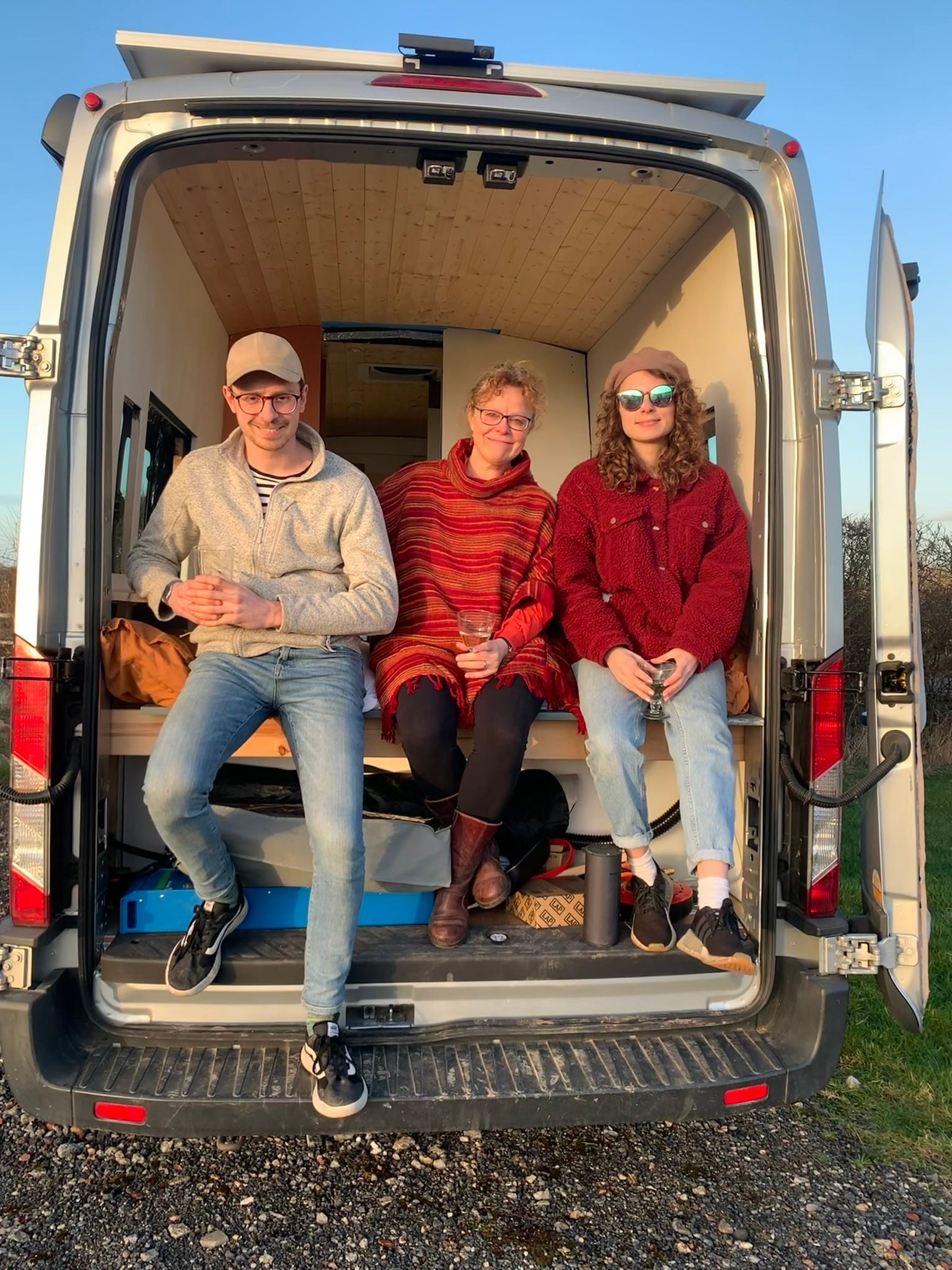
It’s three and a half years since this photo was taken. My daughter and I were sitting with her brother in the boot of his camper van, looking out onto the beautiful meadow where their older brother had been buried, at the end of May, in the previous year. This was the first of what would become our annual family gatherings to mark Dom’s birthday.
I can see from my eyes that I’d been crying. At the same time, I remember that my heart was bursting with love for all my children, the ones who literally (and metaphorically) remained by my side, and the one who now lay at peace under a blue sky. As if the evening sun sensed the warmth in my heart, the field where my son now lay was bathed in the golden hue that I’ve always loved.
In all three of us I see the determination that Dom always showed, to keep going, believing in a better future…
MAKING CHOICES
This post is all about what that future looks like, after we’ve lost our child. And, in what I know Dom would consider an amusing contradiction (because, in terms of that van, we’re facing the wrong way) it’s about how making the commitment to keep ‘Facing Forward’ can help us to move beyond the trauma of our child’s death.
Which is not the same as ‘moving on’, because this seems to suggest that we can somehow detach ourselves and waltz off, nonchalantly, into our new life, leaving our sorrow behind. This is not something any parent can, or wants, to do.
I’ll never subscribe to any notion that I no longer need to feel sad about my son dying. It will always feel tragic that his life was cut so short. As such, I will grieve his loss for the rest of my life.
But I believe how I grieve him now is something that I get to choose.
I want to enjoy these years I have left. I don’t want to live a half-life, dragging my pain behind me, allowing it to contaminate all the happy moments that come along.
Because, although living as a bereaved parent is not what I would have chosen, this is the life I have been given, and I want to be fully present for all the good things that still exist, as well as those which lie ahead.
HOPE, HEALING & JOY
Those of you who have read my previous posts will know that two series preceded this latest one. I first started writing on Substack in February, focussing initially on my ongoing trauma because, almost 4 years on from his death, I was still feeling triggered by memories of my son’s mental health struggles in the run-up to his suicide.
I believe there is a timeline to parental loss. At the beginning (and for a long time) we are in the middle of a maelstrom. This is our only reality, and contemplating any better kind of future seems impossible. It’s at this point that we most need to hear about other parents who have survived this agony, because even though it feels unattainable for us right now, seeing that they have been able to continue living meaningful lives is the closest we can get to feeling HOPE.
In my next series I considered the work, probably the hardest job we’ve ever had, which we are called to do in the ‘middle’ of our journey, to release ourselves from the patterns of negative thinking which can serve to pull us back, over and over again, to those dark early months, preventing us from experiencing the HEALING we need.
In this, my third series, Facing Forward, I want to explore how we can begin looking ahead, recognising that we won’t find the peace we deserve if we keep looking back. I want to challenge the narrative that facing forward is just moving on, showing instead that carrying our child now in our hearts, means we maintain our relationship with them, so that they remain an essential part of how we live, forever.
But just as essential is our belief that we deserve to be happy. Because in believing this we can allow our grief to co-exist with a welcome sense of JOY returning to our lives once again.
PLANNING FOR THE FUTURE
Anyone who knows me will tell you that I’m a great planner. More fool me of course, and what a message the Universe decided to deliver by taking Dom away, because that wasn’t the plan I had in mind at all.
Why then do I continue to believe I can predict the future, haven’t I learnt my lesson now? Isn’t my/our child’s death proof that anything can happen, that any sense of control is illusionary?
Well, whilst I do now understand that we can’t ever know everything that lies ahead, I still believe that we stand a much better chance of creating an outcome we’d prefer if we make wise choices, ones that align with where we want to be in the future.
Because, in many ways, the life still to come will be just a manifestation of what we are doing now. At this point in time the future doesn’t exist, it simply rests on the choices we are making in the present. Which means that, far from having no power over it, I believe, moving forward, we can directly influence how our life is going to be.
So that’s the manifesto! Brave words of course, and a rallying cry (to myself.) But what exactly does Facing Forward look like? And, importantly, what are the things that deter us from looking forward, and what can we do to stop ourselves feeling defeated by them?
THINGS THAT CAN MAKE THE FUTURE LOOK SCARY
I believe most of us have, at some point, felt resistance to moving forward, that we’ve cited at least one of the following reasons for not doing so. In countering each of these, I’ve provided clickable links to my previous posts from series two (Obstacles to Healing.)
There’s no incentive to look to the future because people will just think I’ve recovered and stop giving me the kindness I still want and need.
This is where Self-Compassion is (quite literally) our friend, because offering ourselves the kindness we so need provides us with a much more reliable source of comfort than waiting for others to give it to us.
I actually did wrong, so I don’t deserve to be happy or have anything other than a miserable future.
The Complicated Guilt our compromised brains try to process when our child has died, ends up sending us all sorts of (frankly) stupid messages. Self-forgiveness is vital, and the most helpful starting point is remembering that our children would never have wanted to hurt us…and even if you believe they would (which must feel terrible for you, and I am so sorry) it was their illness which affected their thinking this way.
I’m alone because no one else gets what I’m up against, and there’s no point in making all this effort when it’s not even witnessed by my friends.
Truly you’re not alone…other parents out there get it, they’re in your Tribe. Support Groups for Bereaved parents will welcome you with open arms, and I know for a fact that there are a lot of us on Substack…
Going into the future means I will leave my child behind and that is completely unacceptable to me.
You won’t ever stop being the parent to your child. You will continue to love them, forever. And because you share an Unbreakable Bond with them, you can get to express this in any way you choose now.
I am haunted by the trauma, completely unable to free myself from the thoughts of my child’s death, and nothing is going to change that.
This is a BIG one, and I’m going to address it in a bit more detail below, but you might like to look at my post Acceptance when I reference the mantra that has helped me so much, ‘Not Happening Now.’
PROCESSING TRAUMA
If, like me, you have felt (or maybe you still feel) drawn to looking back on all the distressing circumstances of your child’s death, I truly believe that you can choose to stop doing this. Granted it’s not easy, if you’re still actively triggered by memories, or stuck in self-recrimination and guilt. I’ve found writing has helped give me a sense of agency over my trauma, and self-compassion has allowed me to forgive myself (because I have come to realise that my harshest/only critic is me.)
It’s not for everyone, but I’ve heard really good things about EMDR as a form of therapy to uncover and dislodge distressing memories which can hold us captive. And of course, conventional therapies are another option. Just make sure your therapist is experienced in working with traumatised people.
My point is that, in the long run, taking the really disturbing aspects of our child’s death into our future lives is only optional. Personally, I find thinking about these robs me of the opportunity to grieve my son in the way I want to and knowing this has really strengthened my resolve to stop letting my trauma run the show.
PERMISSION TO GRIEVE
Enough of your preaching, I hear you say! Surely how my child died is intrinsically tied up with my grief for them now?
I get why you feel this (I did for a long time) but, respectfully, I now disagree.
The purest expression of my love for my child (which is what this grief is all about) is my sadness at what I lost when he died. And that is based on who he was and what he meant to me.
Led to its logical conclusion, that makes my grieving for him a way of celebrating him. Of course, it’s a sad way to do this, and I’d much rather be telling him in person how much he mattered to me, preferably without tears rolling down my face as I sob wretchedly because he’s not here anymore.
But the thing I’ve learned about these grief bursts is that they’re therapeutic. I had one a couple of days ago (it’s been a while so it shouldn’t have been a surprise to me.) They always feel awful at the time, like we’re back at square one, sitting defenceless as we reckon with the tragedy of our child no longer being here.
But they pass. And I don’t know about you, but I always feel better afterwards. Because, in crying because I miss him so badly, I’ve just let Dom know that he’s not forgotten, that I care deeply about him still, and that’s never going to change.
I want him to know that, and I want to witness myself too, acknowledging this simple but deep truth. That’s why I’ve learnt to always give myself permission to lean into my grief in this way.
So let your grief move through you. Allow it a space where it can visit, then leave again. Like a familiar guest, to whom you’ve entrusted a key, tell it that it can arrive and go when it wants to.
And that meanwhile, you’ll just get on with your life.
BRINGING OUR CHILD INTO THE FUTURE
For me, ‘facing forward’ means I’m committed to integrating the loss of my child into my everyday life.
I accept that moments of deep grief will still affect me, but I’ve learnt the importance of self-compassion at these times and remind myself that I’m in a state of ongoing recovery with no time limit. When I can, I celebrate being in a better place, always remembering what it took to get here. In doing this, I’m strengthening my desire not to go backwards, cultivating instead a strong pull towards the future.
And in this, my future life, I know that I can call upon my son, whenever it feels right, to help me.
Because I realise that finding joy amidst the sadness will always require effort, and will sometimes feel like a precarious balancing act, not unlike the one Dom managed to perform to stop that ‘silly’ chicken hat falling off his head. But I know it will be worth it, because rather than looking for him in the pain/trauma where he (fortunately) no longer is, the future is where I can reconnect positively with my son, actively choosing now to focus on the happy times we got to spend with him in the past.
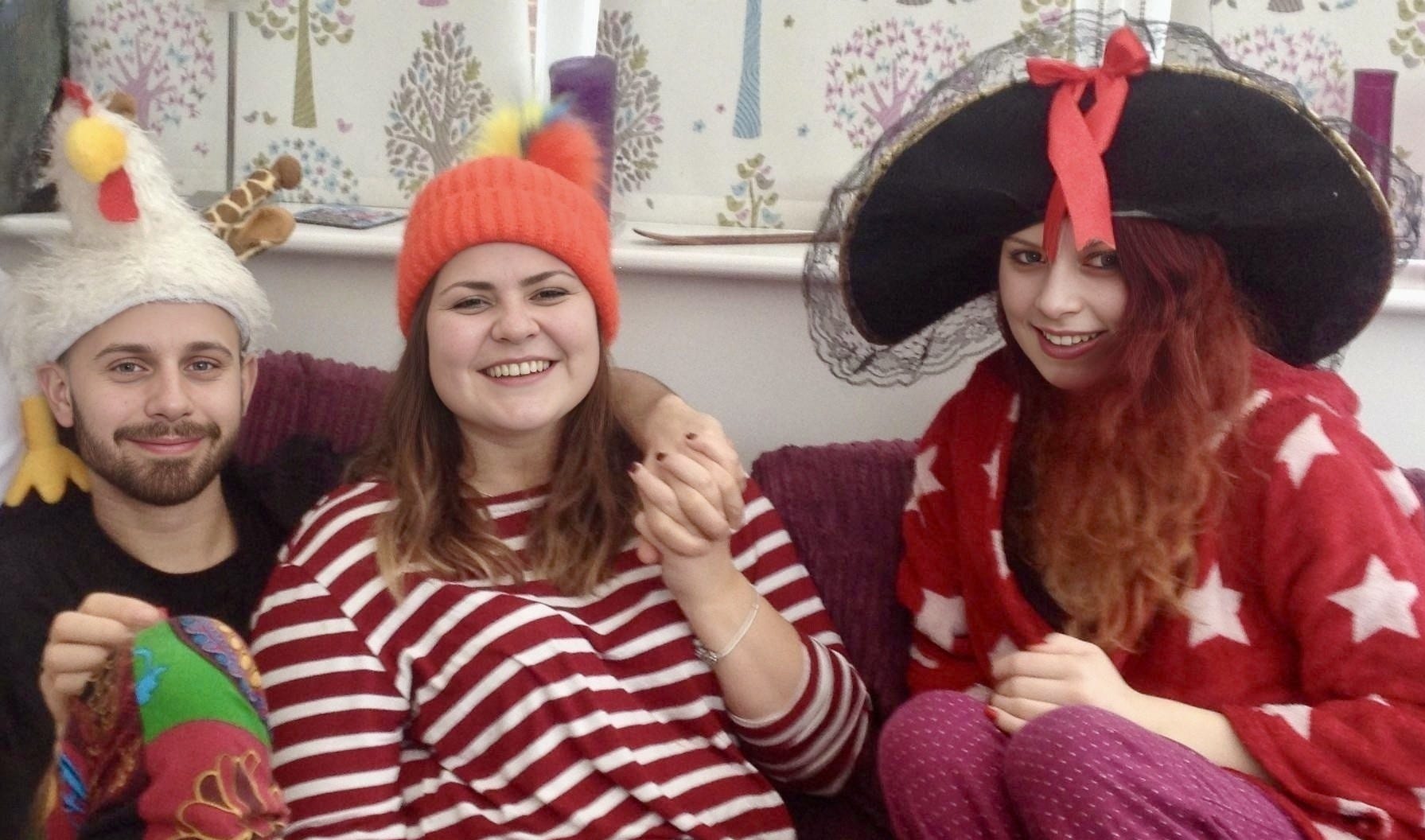
Photo taken on Dom’s Birthday in 2017. Silly Hats obligatory, of course!
There’s one more reason to keep Facing Forward. It means I’ll once again be able to ‘Look Forward’ to what’s ahead. To the good and joyful things which I know are still to come.
And I’m really looking forward to including them in my next posts!
The day Sheila died, I said to my husband, we can not do the "what if" game. There is nothing we can do now to bring her back--we need to look ahead and figure out a way to say grieve while moving forward.
Have I had zero what if moments? No. But they have been maybe three in the past 23 months and they have not lasted long. I cannot even imagine never missing her--that is ongoing.
I really appreciate your wisdom and your writing.
Sending hugs...many good points here. Like many things in life, it's a difficult thing to comprehend unless you've lived it. Healing from child loss is an ongoing, ever-changing process but one that can teach us so much.