

Unbreakable Bonds
...and finding my son again


May 2021 on a walk in a local wood with Ollie, my old dog.
You’re not here. Why aren’t you here?
I’m shouting and sobbing at the same time, sounding childish, even to myself. Asking questions that have no answers. My intense grief at losing Dom has reduced me to howling into the void, where he most surely isn’t.
It’s less than a month since he died, so it’s all incredibly raw. But I wonder if it will ever go away, this fruitless searching for my child…
Of course, Dom wasn’t a child when he died; he was a 30-year-old ‘young man’. Fiercely independent, like my other two children he’d been brought up to be resilient, resourceful and able to stand on his own two feet.
But depression is a cruel monster which could, and frequently did, inexplicably pull the rug from beneath him.
He’d first admitted his thoughts of suicide to me in 2016, and over the following 5 years had told me each time they’d recurred (not always directly, but when you know, you know.)
So, I wasn’t really surprised when, at the beginning of April 2021, the bleak thoughts returned.
As usual, he put up a good fight. But by the end of that month the black dog must have well and truly brought him to his knees. Because that’s when we lost him.
Screen shot from my phone of WhatsApp voice-notes in Lockdown between Dom (texts and voice-notes in blue) and me (voice-notes in green)
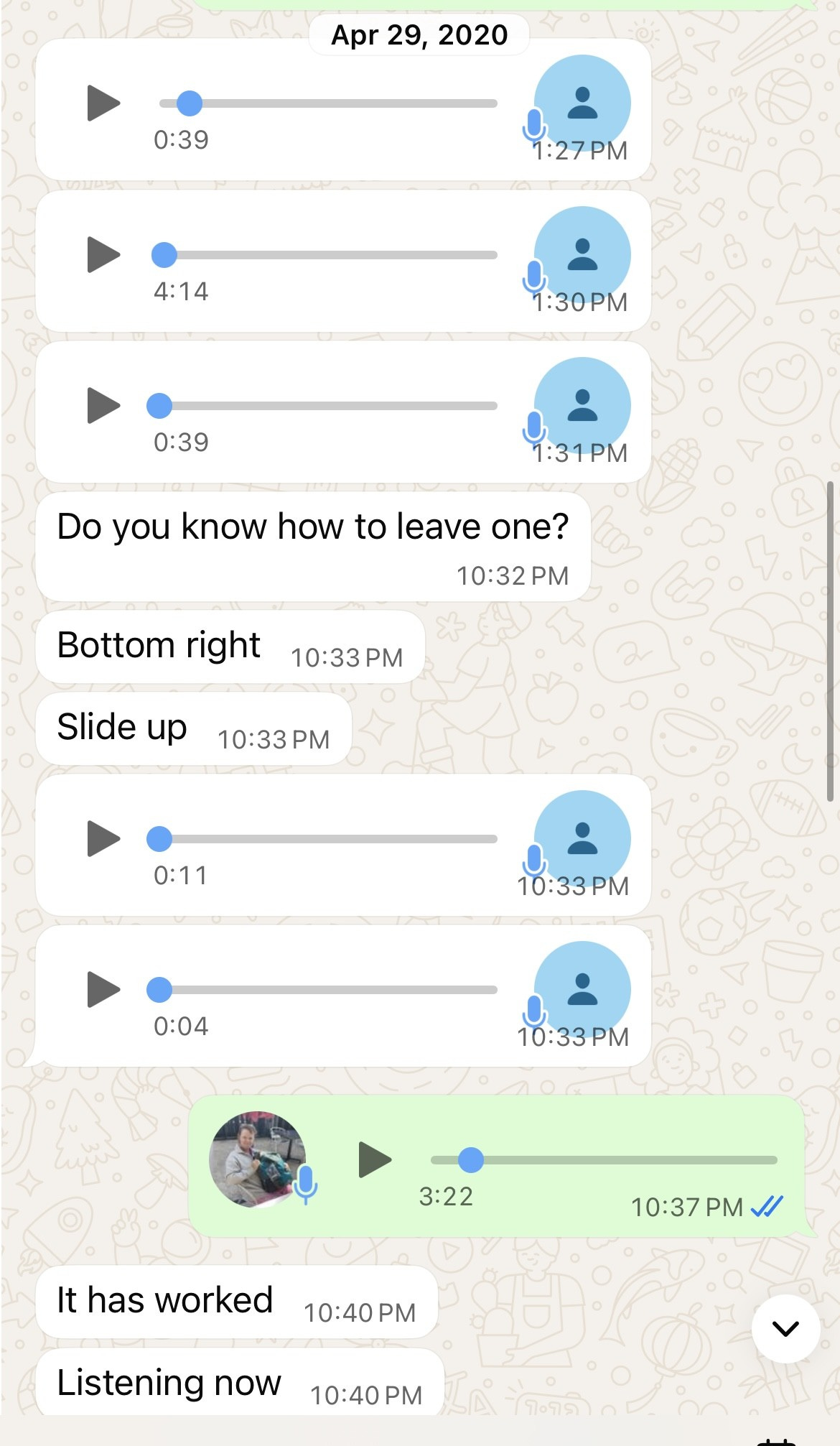
It was 2020 and we were in the first Lockdown. Dom was in his flat in Peckham and I was at home in Oxfordshire. My other two children were also now living in London and so Covid regulations meant I couldn’t physically see any of them. Ever creative, as part of his ongoing efforts to keep the social wheels turning, Dom had developed a habit of regularly sending voice-notes to his family and friends. No one appreciated them more than I did.
Over a string of three messages - filled with the crunch of freshly popped popcorn, his favourite - he told me about his latest madcap idea: a festival food van called Pimped Noods, where he’d serve jazzed-up Super Noodles for a tidy profit.
At the time, I didn’t even know how to record a voice-note. But in his third one, unprompted, Dom had decided to gently encourage me to give it a go:
“It’s like leaving a message with no time limit. For me it’s a really awesome way to communicate. Kind of like nothing else.”
He ended by saying….
But I’m going to wait till later on in this post to say what that was.
I only got to listen to these voice-notes later that evening. Hearing Dom so upbeat made me smile, because his enthusiasm for new ideas was always infectious. So, I called him for a proper chat, and to let him know that one of his pension forecasts had arrived. Like a lot of young people, by this point Dom had worked for several different companies so none of his pensions amounted to much and I knew he’d greet this latest news with cheerful resignation.
As part of our conversation, he had another go at persuading me to begin sending him voice-notes. And after the call ended, he immediately texted…Do you know how to leave one?…followed by simple instructions…Bottom right…Slide up…before giving his technically challenged mother a fuller description in another two of his own.
And so, I succeeded in sending my first ever voice-note, and was delighted when Dom confirmed he’d got it: ‘It has worked…listening now.’
I’ve just listened to my message again, to remember exactly what I said. In as serious a voice as I could manage, I read out Dom’s most recent (and pitiful) pension forecast. He was earning a princely £1 a month - plus 13p in annual profit share. Barely able to contain my laughter, I went on to report that the overall growth of this pension was in minus figures…even though the company suggested that he might like to invest it!
Dom, a great fan of the ridiculous, chortled in his return voice-note to me, suggesting that ‘Maybe it could be a regular feature of our lives where you open my mail and read it out to me like this…’
Oh, how I miss Dom’s laughter and our being silly together. I’m so grateful I have these precious recordings, to listen to still (although they can also make me cry.)
I’ve written on my Substack about what it means to yearn as a bereaved parent. It’s a deep, hollow craving, a constant, aching pull towards your child. And it’s perhaps the most painful and enduring part of our loss.
Four years on from Dom’s death, I’ve begun wondering why this yearning has assumed such huge proportions for me. After all, I am very conscious of how ‘lucky’ I am to have two surviving children, Dom’s younger brother and sister. But I accept they have their own lives, and don’t fixate on them. Whereas Dom, well I think he must be in the back of my mind all the time, so much so that, when I see a young man of his age wearing his cap back-to-front, just as my son did, I can feel like a stalker, following him with my eyes until he’s out of sight.
Sometimes I wonder if I’m verging on being obsessed with my dead son. Is it because, since I know he’s forever gone, at its most basic I want what I know I can’t have. Which, once more, seems almost childish. Then again, I’m probably experiencing the confusing and distressing feeling of severance from him. So, like a phantom arm, I keep sensing it’s still there, which means I’m constantly looking for it, in the place it used to be.
However they die, the loss of our child will most probably feel like a tragedy. And so our grieving will most likely be complicated, and intensely painful.
Four years after losing Dom, I’ve come to believe that the only way to soften that pain is to find ways to carry our child inside us. Not just in memory, but in something active, alive.
A continued relationship.
So much attention is still paid to the “Seven Stages of Grief,” but I’ve found more comfort in Bowlby and Parkes’ Four Stages. Their second stage - Yearning and Searching - resonates deeply. It describes our desperate urge to reconnect with the one who has died. Not to let go, but to find a thread that still ties us together.
That’s what parental grief feels like. And I believe our ability to walk forward - not away from our children, but into this ‘new’ life with them - depends on finding those threads.
This, I believe, is where healing begins.
Of course, it’s a complicated kind of healing. Because the source of our pain is also the source of our comfort. Our love, our heart. The very place where grief tears us open, is the same place where our child still lives within us.
Over time - and it takes as long as it takes - I believe that our intense yearning can begin to shift. Into something quieter. A deeper, steadier form of love that begins to fill the space their physical absence has left behind.
Psychologist Dennis Klass calls this the theory of Continuing Bonds. The idea that our relationship with someone doesn’t have to end when they die, it simply changes form. You might visit a favourite place, cook a dish they loved, or support a cause that mattered to them. These acts don’t just preserve memory, they maintain relationship.
What I love about this theory is that it rejects the idea of ‘moving on’ or ‘finding closure.’ Instead, it recognises that our loved one is still part of our lives. And that feels far truer to me than anything else I’ve read.
But, for me it’s still not enough. I need to feel a more direct connection with my son.
And that’s why the most powerful bond I’ve created with Dom is that of continuing to communicate with him, via those voice-notes he taught me how to send, five years ago.
It may sound strange, but many bereaved parents say they still talk to their children in some way. This is how I have chosen to keep talking to Dom. I began sending voice-notes again a year after he’d died, using the same WhatsApp thread we messaged on when he was alive.
It’s fair to say, that little green app has become my sanctuary.
I usually send my voice-notes while walking our new dog, Sonny. I record two: one from me to Dom, and then one from Dom back to me. I always start his with, “Hi Mum,” and just let the words come.
It’s not difficult to imagine what he’d say. We had endless conversations while he was alive. Voice-notes were our rhythm. Sharing news, joking, encouraging one another. That rhythm continues now.
Once I’ve sent the new messages, I listen back to the ones I recorded a few days earlier. My memory’s not what it used to be, so I’m often surprised by what I hear, just like I was with his real messages.
And yes, of course I know Dom isn’t here to actually listen or reply. But that’s not the point. These voice-notes are the closest I get to speaking to him again. And they help with the yearning. They really do.
In the early days, my messages to Dom were raw with anguish. And I couldn’t find a shred of kindness for myself. But my son’s imagined replies - full of gentleness, reason and love - gradually helped to change that. He told me to stop blaming myself. To understand that it wasn’t my fault.
In giving him a voice, I began to find my own compassion.
Of course, there are still days when grief knocks me flat. When I leave tearful messages and feel like I’m back at the beginning. But when I listen to his replies, I’m always struck by the kindness, the insight, the gentle wisdom that somehow leads me back to a place of calm.
I’ve come to realise that channelling Dom’s voice helps me tap into my own inner wisdom, the part of me that wants to heal.
These days, most of our voice notes are much lighter. I tell him about what’s going well. And he replies with enthusiasm and pride.
Afterwards, I always feel uplifted. Like I’ve just caught up with an old friend. Which is why - and he’d love the pun - I’ll say it out loud: I feel buoyed up, by my boy.
There were moments, in those early days of sending voice-messages to Dom again, when I’d wonder: was I actually coming to terms with my grief or was I still that mad woman walking in the woods, desperately howling for her lost child.
Was this just another form of insanity?
But now I don’t think so. Like many grieving parents, I know that I’ve simply found a way to keep my child with me. I wish he was still here in body, of course I do. But it’s come to feel like he’s everywhere else. And I’ve learnt to settle for that.
Anyway, I choose to believe this isn’t madness. It’s magic.
Because, as that screen shot of our texts and messages shows, the date when Dom first taught me how to use voice-notes was 29th April 2020. Which means, in what feels so significant, that he showed me how we could stay in touch, via these, exactly a year, to the day, before he died.
I only registered the coincidence of these dates last summer, when I began writing my book, ‘Walking with My Son.’ Frankly, it blew me away.
But there was more.
By this point it was 2024 and I’d been sending voice-notes back and forwards between me and Dom for two years. Curious as to what he’d said in the first messages he’d sent that day (precisely a year before I lost him) I decided to listen back, properly this time. And the third one stopped me in my tracks.
The one that he ended by saying…
‘If you send them, I’ll send them back.’
And so, if you still talk to your child, through letters, voice-notes, dreams, conversations in your head, know this: you’re not alone. You’ve found a way to bridge the invisible space between where they are and where you remain.
And if you haven’t yet, but long to… I say go for it!
You don’t need a medium. Just your memory of how it felt to talk to them when they were earthside. Pick up where you left off. Trust the bond. Trust yourself.
Say what you most need to say, and if it feels right, let them say what you most need to hear.
Because nothing, not even death, can break the bond you share.
If this post resonated with you, I’d love to hear how you stay connected with your child. Please feel free to share in the comments below. And if you're in those early, fragile days of grief, I want to offer something that helped me….
This YouTube meditation, gently invites you to reconnect with your loved one. I found it immeasurably comforting when I needed it most. Perhaps it will offer you the same.
This is an achingly beautiful post.
Esther, my heart truly goes out to you. I deeply understand the longing you feel. Oh, how I would cherish hearing my son’s voice again! It warms my heart that you have Dom's voice notes—they are such a beautiful treasure. Sending you love and hugs!