

Co-Destiny...
and why it will always be my favourite Grief Theory

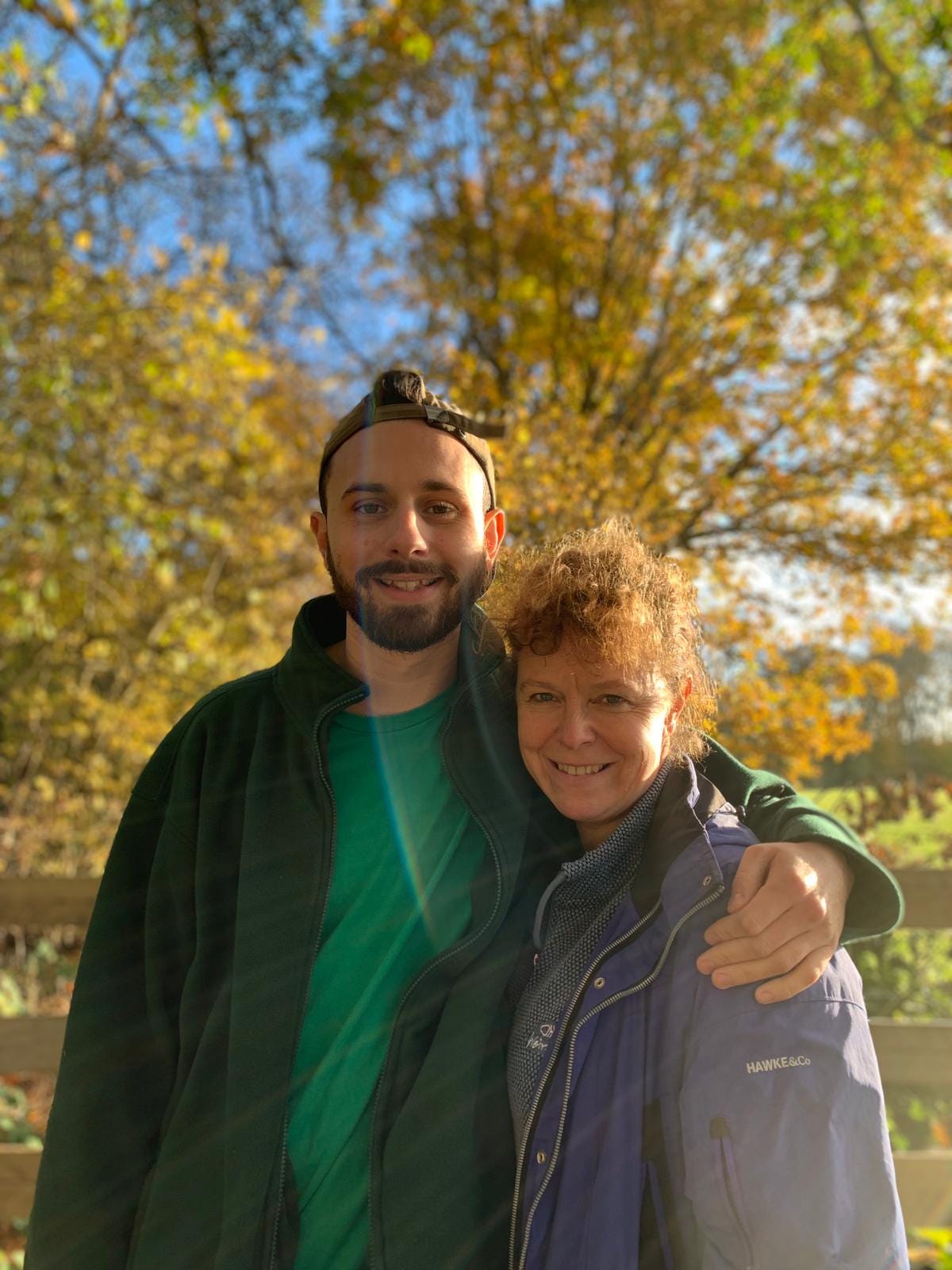
Dom and I on a walk in 2018. Taken by his brother, Marcus.
This post is going to be a good deal shorter than my recent ones. Thank you to everyone who has invested precious time (imo our most valuable commodity) in reading my considerably longer recent ones. And to my daughter whose entreaty is always that I make friends with brevity!
I’ve referenced many different grief models in recent posts, and I’d like to end by discussing two more. The first one (The Dual-Process Model of Grief) explains the workings of the mind, when in grief, and shows why the process of grieving is neither straight-forward nor linear.
Created by Stroebe and Schut, this models how grievers tend to “oscillate” between loss-oriented and restoration-oriented phases, explaining how looking backwards, and missing what we have lost, alternates between our focusing on the future, and rebuilding our disrupted lives.
In the loss phases, we grieve and yearn, and we are resistant to change. We want to feel better, but we also don’t, since our grief feels sacred, so we hold it tenderly. I know from experience that, after we lose our child, we can remain in this place for what can feel like an endless time.
In the restoration phases, although we don't forget our grief, we now become open to change, stepping bravely out into the world, doing new things, perhaps with new people. Welcoming distraction from the pain, we begin to look forward, instead of back.
Of course, when we have lost our child, this can feel like an unknowable, inaccessible place. In fact, small attempts to ‘resume’ our previous life can end up back-firing, making us feel even worse.
Adjusting socially to being a bereaved parent is complicated, because what previously felt comfortable and easy may now be exceptionally tough. Going to a party, where everyone is seemingly oblivious to the pain we are carrying, can be excruciating. I remember clearly on my first Christmas, only 8 months after Dom had died, standing in a kitchen surrounded by the carefree laughter of my (lovely) friends and wondering why on earth I was doing this to myself. I think staying home may have been better for me at this point, although I know that I’d have seen that as a different kind of failure.
I’ve come to believe that it’s best to keep to tiny steps, as you move towards restoration. Even something as unremarkable as resuming an exercise routine, can represent a massive challenge, and it’s important to recognise that we deserve respect for our efforts, if only from ourselves. Because, even in these incrementally small moments, we are showing such bravery in starting to live again, attempting to grow into our ‘new’ life.
After our child has died, there’s no winning at this game of grief, just a long hard slog back to a new ‘normality.’
Swinging between the extremes of grieving and growing is hard. What we most need is some ‘safe’ middle ground, a place where we can rest, but, especially in the early stages of complicated loss, it can feel like a seemingly impossible job, building this new version of peace. What I like about the Dual-Process Model of Grief is that it shows how grieving is ‘work,’ and this explains why it can feel so emotionally exhausting, and possibly the hardest thing we have ever had to do. So, feeling tired and irritable is normal and we need to give ourselves grace while we’re doing this.
If we are lucky, those around will do the same, making concessions for us when we’re not able to be our best selves. But if they can’t (or maybe choose not to) we’re faced with relationship challenges, which is distressing when we are already feeling so very fragile.
The Dual Process model describes how oscillating between grieving and restoration is normal, and suggests that, as time goes on, what can feel like wild swings between these states will even out, as we move towards our goal of sustained restoration.
But I know, from personal experience, that moving into restoration, even temporarily, is a real challenge to grieving parents.
I’m going to stick to my promise of keeping this short and leave it at that, but if you haven’t already, you might like to look at my previous posts from June this year, because in these I’ve described some of the obstacles standing in the way of parents taking tentative steps in the direction of healing (which is really what restoration is all about.)
What I’d like to end by describing is my favourite grief model of all, ‘Co-Destiny.’
This one (a term coined by Joseph Klass) sits alongside his grief theory of ‘Continuing Bonds’ which I wrote about in my previous post, ‘Unbreakable Bonds.’
But Co-Destiny takes this further. Because it gives us the opportunity not just to carry on our relationship with our child, but to continue to shape their destiny, by staying true to the best of who they were, before their lives were tragically cut short.
Put simply, if you feel that not only you, but the world, lost something special and valuable when your child died, you can choose to keep their influence alive, in how you live your life now.
In this way, your child’s destiny and your own become interwoven. Because they get to live on still, through you.
What I like most about Co-Destiny is the way in which it influences our mindset and allows us to change the narrative, both ours and our child’s. It encourages us to see that, rather than continuing despite our tragedy, we are able to live on because of it. In this way it can change our perspective, away from feeling our child’s death was utterly pointless (which of course in so many other ways it was) to recognising that something important remains, and that we have agency over finding this.
So, what have I found, since losing my son to suicide?
If you’ve read any of my other posts, you won’t be surprised to hear that I view the working of this Co-Destiny, with my son, as something I express through my support of other bereaved parents and that the fuel which drives me is the knowledge of how many times my son helped others when they were in acute mental anguish.
I know this because of all the messages we got from Dom’s friends after he died. Knowing how hard it could be to battle depression on his own, he took that awareness and made something of it, not just in those private conversations, but in setting up local Mental Health Support groups (even distributing fliers for one he later ran when he moved to London, and going ‘online’ with it when Covid made it impossible to run in-person.) I wrote about this in an earlier post, ‘It’s Okay’.
I know these groups helped many others, and that they helped Dom too. And that is why I feel so passionately that my Co-Destiny (and the way I get to keep my son in the world) is to dedicate my writing now to increasing awareness of how challenging parental grief is, as well as in building mutually supportive connections with other bereaved parents.
So thanks again for continuing to read my posts, where I try to do this. I hugely appreciate your loyalty and compassion.
And thank you, most of all, to Dom, who continues to walk alongside me as I do ‘the work.’
I truly believe that this is now our shared destiny.
If you have lost someone very precious, and the idea of Co-Destiny resonates with you, I’d love to hear how you have continued to weave their destiny into the life you now live. Please let me know in the comments below!
Oh Elaine, I’m so incredibly moved by your sharing this with me, and at such a tender time in your own journey honouring Elliot. What a wonderful way for Eliot’s impact to be continuing through Mo-Ranch…and how amazing that the email came today. ✨
Co-Destiny speaks to so many of us I think because the relationship with our child truly never ends…and finding a way to express and maintain it in the way which is most meaningful to us and them softens the physical goodbye which is such a source of pain to us. They are still with us, these precious boys and girls…we just need to look in the right places ❤️
I really identified with this post. Thank you. My husband subscribes to co-destiny. I’m getting there.